Industry · Food and fine food
Food ecommerce websites, for gourmet food brands.
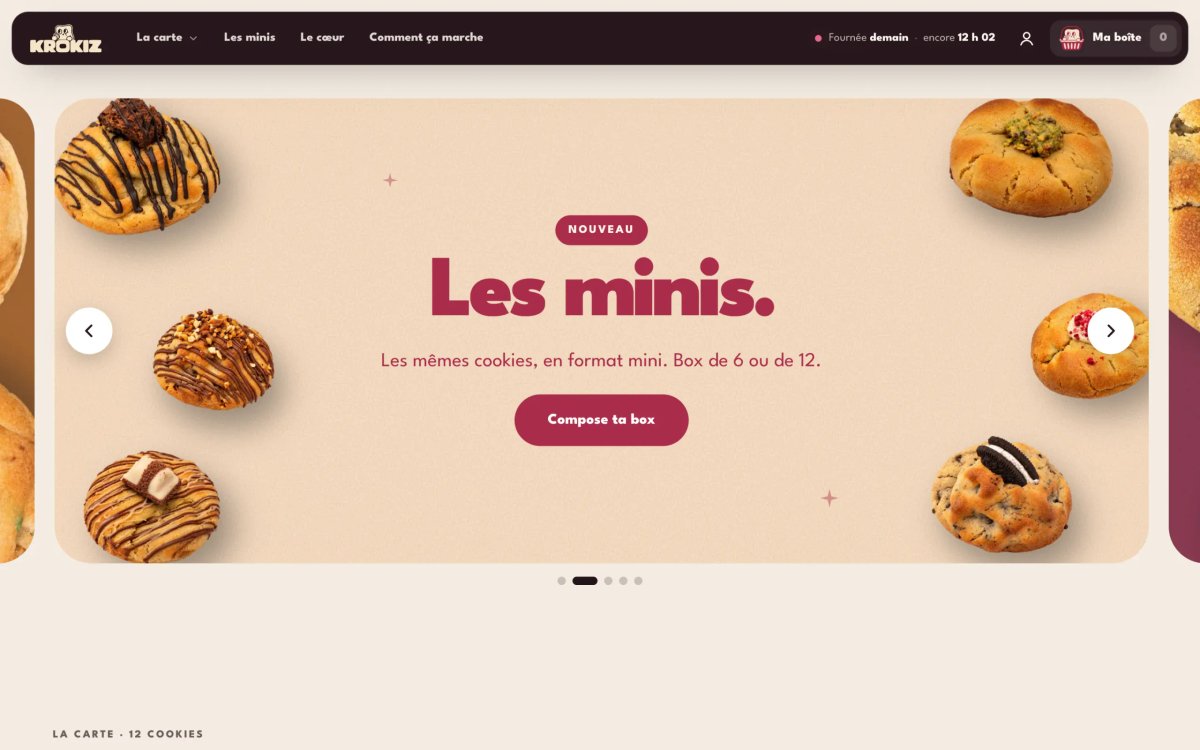
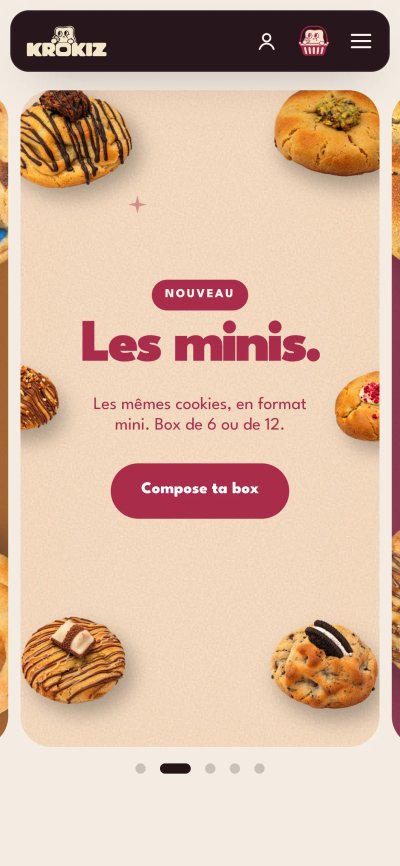
A food product is tasted before it is bought, carries a date and allergens, and has to arrive in the state it left in. In distance selling, the EU food information regulation (1169/2011, known in France as INCO) also requires the mandatory information to be readable before the order. Lyvora designs food ecommerce websites on Shopify around these constraints. For Krokiz, we built the store and the mobile app, on iPhone and Android, connected to Shopify. Gift boxes, subscriptions, local pickup: each project starts from the way you sell.
Food stores on Shopify

Four ways to sell food.
A biscuit maker that ships and a neighbourhood bakery do not need the same website. Choose the profile closest to yours.
Gourmet brand
Objectif
Sell products made to a date, often fragile, online, and deliver them in the state they left in.
- Publics
- Customers ordering for themselves or as a gift
- Companies ordering end-of-year gift boxes
- A community that follows new recipes
- Key pages
- Product page: ingredients, allergens, storage
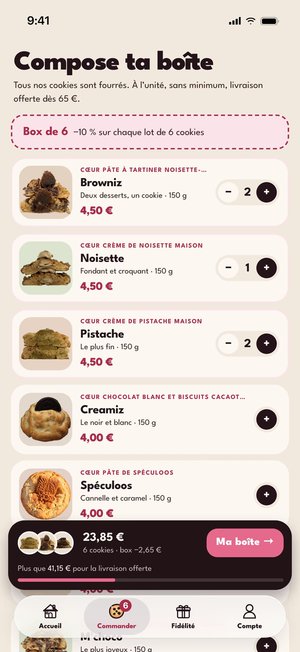
- Build-your-own box or gift set
- Shipping page: zones, dispatch days, packaging
- Gifts and corporate orders page
- Conversion
The online order, often a box the customer has put together, then the next order.
Tea, coffee, dry goods
Objectif
Sell a product people buy again, and bring the customer back when the pack runs out.
- Publics
- Enthusiasts who compare origins and flavours
- Customers who reorder their usual product
- Restaurants and shops that resell
- Key pages
- Detailed product pages: origin, preparation, storage
- Browsing by flavour, moment or use
- Reorder or subscription from the customer account
- Page on making or packing
- Conversion
The first order, then the reorder, by hand or by subscription.
Delicatessen
Objectif
Run a catalogue from many producers, with stock that moves, and present it as a selection.
- Publics
- Customers looking for a specific product or a gift idea
- Companies, for gift boxes
- Customers of the physical shop
- Key pages
- Collections by producer, region and use
- Curated gift boxes and gift cards
- Local pickup and local delivery
- Producer pages
- Conversion
The online order or pickup in store, and corporate gift boxes.
Bakery and patisserie
Objectif
Take orders in advance and have them collected in store, with no queue and no phone calls.
- Publics
- Local customers
- Orders for events: birthdays, weddings
- Neighbouring businesses
- Key pages
- Products to order and the current menu
- Choice of pickup day and time
- Event orders page
- Opening hours, address and directions
- Conversion
The order with pickup in store, at the chosen time. Without online payment, a brand website on Webcosa is often enough.
Five challenges for a food store.
Regulation, dates, shipping, reorders and the end of the year: what a general-purpose store does not plan for.
-
Enjeu 1 : Mandatory information before purchase
The problem
Name of the food, ingredients, allergens, quantity, storage conditions: in distance selling, the EU regulation wants this information available before the order, with allergens emphasised. Copied by hand, it ends up wrong on a product page or two.
Our answer
Each mandatory item is a product field, shown in the same place on every product page, allergens emphasised. A new product does not go online without them.
Indicateur suiviProduct pages with complete regulatory fields
-
Enjeu 2 : Products with a date
The problem
A food product has a use-by or best-before date, stock-outs and seasonal returns. A store that shows as in stock what no longer is disappoints, and a badly announced stock-out loses the customer.
Our answer
Stock-outs and seasonal returns are managed from the Shopify admin, with a back-in-stock alert.
Indicateur suiviOrders cancelled because of stock-outs
-
Enjeu 3 : Shipping fresh or fragile goods
The problem
A biscuit that arrives broken, a chocolate that has warmed up, a parcel that waits over the weekend: shipping is part of the product, and dispatch days and delivery zones change with what is sold.
Our answer
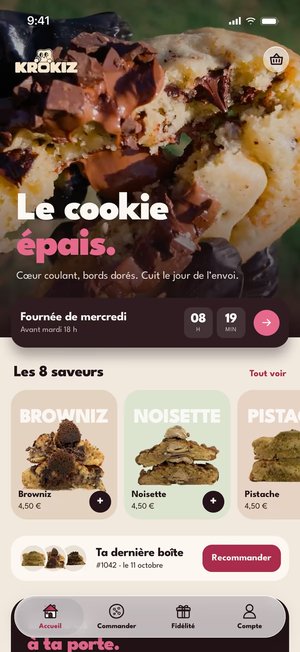
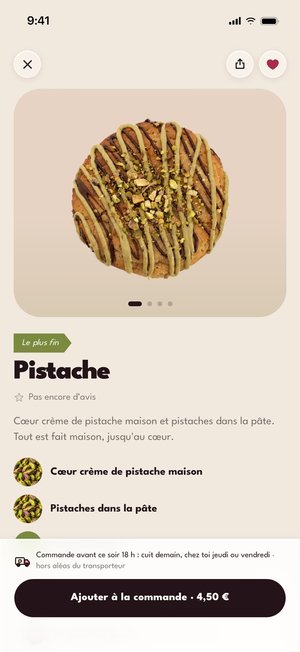
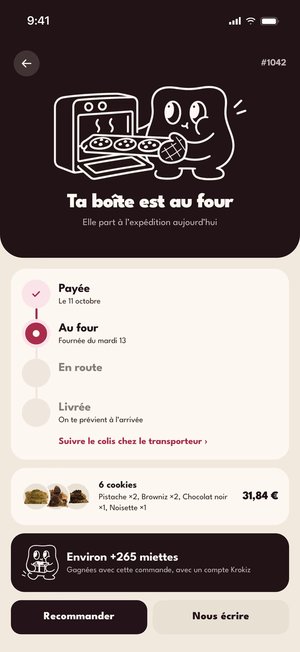
Dispatch days, zones, carriers and packaging are set at scoping, and the product page says when the order will leave. Krokiz bakes its cookies on the day of dispatch: its app shows the day’s batch and the order countdown.
Indicateur suiviComplaints linked to delivery
-
Enjeu 4 : Reorders
The problem
A tea, a coffee or a box of biscuits is bought again. Without a customer account, a reminder or a subscription, the second order depends on the customer’s memory.
Our answer
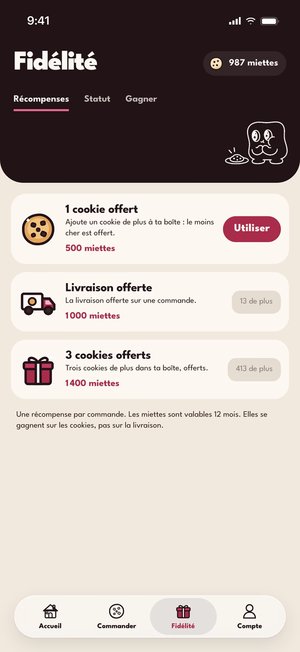
Reorder from the customer account, a subscription through an app when the product lends itself to it, and a loyalty programme when the brand has one. In the Krokiz app, points convert into a free cookie or free delivery.
Indicateur suiviShare of customers who place a second order
-
Enjeu 5 : Gift boxes and the end of the year
The problem
Gift boxes, corporate orders, Christmas calendars: part of the sales is played out over a few weeks, with bigger baskets and tight deadlines.
Our answer
Build-your-own boxes, gift cards, a page for companies, and sections your team prepares in the editor and then publishes on the chosen day.
Indicateur suiviGift box sales, year on year
A store made for food, not for anything else.
| Sujet | Approche courante | What we do |
|---|---|---|
| Mandatory information | Copied into the description, case by case. | Fields per product, allergens emphasised, shown the same way everywhere. |
| Shipping | Costs and lead times discovered at checkout. | Dispatch days and zones stated from the product page on. |
| Reorders | A new order to place from scratch. | Reorder from the customer account, subscription or loyalty when the product lends itself to it. |
| Gift boxes | A fixed product for every possible combination. | A build-your-own box, linked to the stock of each product. |
| Pickup in store | Orders taken over the phone. | Shopify’s local pickup, on the chosen day and at the chosen time when needed. |
| Mobile | A site designed for the computer, shrunk onto a phone. | Journeys designed for the phone, and an app when purchase frequency justifies it, as for Krokiz. |
Food stores delivered.
A store and its app.

Method in four stages.
The same for every industry. Each stage ends with your approval.
-
Step 1: Scoping
We start from your catalogue, your customers and your sales channels. Scoping sets the structure of the collections, the information each product carries and the journeys to build.
-
Step 2: Design
The pages that carry the sale are designed for mobile and desktop. You review and comment on them screen by screen in Webcosa Aperçu.
-
Step 3: Development and catalogue
The theme is custom-built, the catalogue imported and checked, payments and shipping set up in Shopify.
-
Step 4: Launch
Test orders, redirects in the case of a migration, analytics checked. Then we show your team how to keep the store running.
Frequently asked questions
Can you sell food products on Shopify?
Yes. Shopify handles the catalogue, payments, shipping and local pickup. What takes work is the mandatory information, the dates and the shipping: they are handled in the theme, in metafields and in the shipping rules.
What information should a food product page show?
In distance selling, the EU food information regulation (INCO in France) requires the mandatory information to be available before purchase: name of the food, ingredients, allergens emphasised, net quantity, storage conditions and the name of the food business operator, among others. The date of minimum durability must be known at the latest on delivery. The content is checked with your supplier or your laboratory; the store shows it the same way everywhere.
Can you offer a subscription?
Yes, with a subscription app connected to Shopify’s checkout, when the product is bought again at regular intervals: tea, coffee, biscuits. The choice of app and plan is made at scoping, according to your production.
Does a bakery need an online store?
Not always. A neighbourhood bakery or patisserie often needs a brand website with its products, its opening hours and an order to collect in store. Shopify handles local pickup; a brand website on Webcosa is enough when nothing is paid for online.
Do you need a mobile app as well as the store?
Rarely at the start. An app is justified when customers order often and the brand has loyalty to keep alive. For Krokiz, the app is built on the Shopify store: orders placed in the app are recorded there.
How do you ship fresh or fragile products?
By setting dispatch days, delivery zones, carriers and packaging at scoping, then stating them on the product page. Depending on the product, the shipping rules take into account the day of the order and the destination, so that a parcel does not wait over the weekend.
Your food brand, let’s talk.
The first conversation is used to scope the project: store, gift boxes, subscription, local pickup, app. It moves faster if you already know:
- The number of products, their formats and how they keep
- How you ship today: days, zones, packaging
- What people buy again, and what sells mostly at the end of the year
- Your current platform and your other points of sale